Posts

Showing posts with the label EAG

Which careers do students go for?

Image
by Marie-Helene Doumet Senior Analyst, Directorate for Education and Skills Career decisions are wrought in complexities. Many students start by looking at their interests, selecting a career in line with their personal affinities or aspirations. They will consider their own self-beliefs in their capacity to perform and succeed in a given career, and then factor in labour market prospects, employment, earnings, and the possibilities to progress in their chosen profession over a lifetime. But career decisions are not only about students’ choices: they also interact with a number of public policy objectives, such as making education systems more efficient, aligning skills to the demands of the labour market, and helping improve social equity. Some countries have sought to promote certain fields or pathways over others through financial incentives or by opening access. Conversely, other fields impose highly selective admissions processes. As students are confronted with more possibilities...

Back to school time: “Think beyond grades – to life”

Facebook Live session with Andreas Schleicher, head of the OECD Directorate for Education and Skills by Marilyn Achiron, Editor, Directorate for Education and Skills This back-to-school moment is a great time to grab a few minutes with Andreas Schleicher, head of the Directorate for Education and Skills, to get his thoughts about preparing for – and succeeding in – the school year ahead. In our Facebook LIVE interview yesterday, he said that “there’s always something interesting happening in school”, and suggested that students “think beyond grades – to life”. Schleicher said of teaching that “there’s probably no tougher job today”. What is common to the best-performing countries in PISA ? According to Schleicher, these countries “believe in the future more than in consumption today; they make an investment in education”; “they believe in the success of every child”; and “they can attract the most talented teachers to the most challenging classrooms”. We also talked about stu...

Building tax systems to foster better skills

Image
by Pascal Saint-Amans Director, Centre for Tax Policy and Administration Andreas Schleicher Director, OECD Directorate for Education and Skills Investing in skills is crucial for fostering inclusive economic growth and creating strong societies. In an increasingly connected world, skills are particularly important for citizens to get the most out of new forms of capital, such as  big data and robotics . More and more, policy makers are recognising that rapid change in technologies and work practices mean that people will have to continually upgrade their skills throughout their lives . This new reality raises many questions for governments, firms and individuals, including: who is to pay for all these skills investments? In many OECD countries, student debt is rising , and in many others, public debts are persistently high. How can policy makers decide on the right financing mix for students and governments? This is where taxes have an important role to play. In a nutshell, deliv...

Why do so many women want to become teachers?

Image
by Dirk Van Damme Head of the Innovation and Measuring Progress Division, Directorate for Education and Skills  It is well known that the share of women in the teaching force is growing. According to the latest  Education Indicators in Focus brief , the average share of female teachers across OECD countries increased from 61% in 2005 to 65% in 2010 and to 68% in 2014, in all education levels combined. Around 82% of primary school teachers and 63% of secondary school teachers are women. Some policy makers see this trend as a cause for concern, citing, among other things, that the lack of male teachers and role models might play a role in the decline of learning outcomes among young boys. But it seems fair to say that few people would be concerned about a similarly skewed gender imbalance in other professions if it benefited men. The statistics on the age distribution of male and female teachers show that the gender imbalance in the teaching profession will increase even more in...

Why should we improve learning opportunities for young kids?

Image
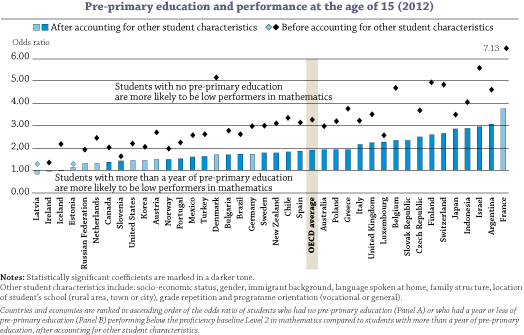
by Dirk Van Damme Head of the Innovation and Measuring Division, Directorate for Education and Skills  More than hundred years ago, nations that are now members of the OECD introduced legislation to set the age compulsory education. Most countries obliged families to send their children to school from the age of 6 or 7. The gradual abolition of child labour and the need for a workforce with elementary skills – two consequences of the ‘second industrial revolution’ – convinced countries to impose compulsory education. Since then, education policy has focused on ensuring that all students are provided access to – and participate in – compulsory schooling. Many countries have also gradually increased the upper age limit of compulsory education. But for younger kids – under the age of 6 – families were seen as the most optimal environment for children’s care and upbringing. But as more women entered the labour force and two-income families became the norm, the context in which children...

Latvia is determined to build on its progress in education

Image
by Andreas Schleicher Director, Directorate for Education and Skills In the 2012 PISA test, urban students in Latvia outperformed rural students by the equivalent of more than a year of schooling – half a year more than the average performance difference between these two groups of students across OECD countries. According to a new OECD report, Education in Latvia , giving equal access to a quality education, for students of all ages, must be a priority. Latvia has made remarkable progress in improving its education system since independence in 1991. Children now start their education at a young age – younger than in many OECD countries – and many continue into tertiary education. Student performance has also improved significantly since 2000, to the point that Latvian students scored near the OECD average in the 2012 OECD Programme for International Student Assessment ( PISA ). Will Latvia be able to continue this positive trend? Yes, but only if the country raises its teaching standa...